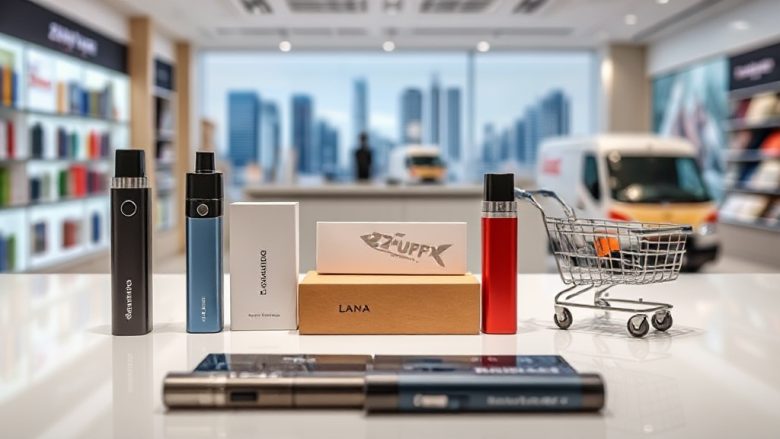
Where the Lana Ultra 2 Sits in Singapore’s Disposable Market
Before judging a lana ultra 2 on its own terms, place it inside the wider disposable format landscape in Singapore. The local online market is not one shelf of interchangeable devices; it is a layered ecosystem of puff counts, form factors, draw styles, and delivery expectations. A shopper who understands that landscape reads a specification sheet differently. They stop asking whether a device is “good” in the abstract and start asking where it fits relative to the alternatives they could have ordered instead. That shift in perspective is the whole point of this essay.
Disposable vapes in Singapore are largely an online retail category. Because buyers rarely handle the product before purchase, the information attached to a listing carries unusual weight. Puff count, battery behaviour, airflow, and flavour range become proxies for an experience the buyer cannot test in advance. The marbo vape 25k and similar high-capacity devices set one expectation, while compact pens set another. Positioning, not hype, is what makes a listing legible.
The Format Ladder: Puff Counts as a Buyer’s Compass
Puff count is the crudest yet most useful sorting tool in this market. It gives buyers a rough unit of comparison across devices that otherwise share few visible traits. At the compact end, a device like the lana pen plus 9k signals portability and a lighter commitment. It suits someone who wants a slim object in a pocket and does not mind reordering sooner. Moving up, the snowwolf 16k occupies a middle band where capacity increases without the device becoming a brick. Then come the 20k-class products, such as the lana pix 20k, which begin to compete on endurance rather than discretion.
This ladder matters because it shapes what buyers believe they are paying for. A 9k device is judged on convenience. A 20k or 25k device is judged on how long it lasts, how consistent the last third of its life feels, and whether the size penalty is acceptable. When a listing sits at the top of the ladder, every other attribute is read through the lens of capacity. That is the context the marbo 25k inhabits, and it is also the context that defines the Lana Ultra 2’s position.
There is a subtlety here that experienced buyers notice. Puff counts are marketing figures, not laboratory measurements, and the gap between advertised and perceived capacity widens as devices get larger. A high-capacity device that fades noticeably in its final stretch can feel shorter-lived than a modest device that performs evenly. So the ladder is not a strict ranking. It is a set of expectations that the product then has to satisfy or quietly revise.
Where the Lana Ultra 2 Sits on That Ladder
The Lana Ultra 2 belongs to the upper tier of the disposable format, the band where buyers are explicitly trading pocketability for longevity. It does not compete with the pen-style end of the market, and it is not trying to. Its natural rivals are the other high-capacity devices that dominate the top of Singapore’s online listings, including the 20k and 25k products that have trained buyers to expect weeks rather than days of use.
Read against that peer group, the Lana Ultra 2 is best understood as an endurance device with a design-conscious wrapper. The “Ultra” naming signals an upgrade path within the Lana family, which already includes the compact pen and the mid-range lana pix. Buyers who have used an earlier Lana product approach the Ultra 2 with a specific question: does the extra capacity change the feel of the device, or does it simply extend the same experience? That question is more revealing than any single specification.
Positioning within a family matters in this market because brand continuity reduces perceived risk. A shopper who liked a smaller Lana device already trusts the airflow and flavour profile enough to consider a larger one. The Ultra 2 therefore enters the conversation not as an unknown but as a known quantity scaled up. Its place in the landscape is defined less by novelty than by how gracefully it handles that scaling.
High-Capacity Expectations and the Size Trade-Off
Every step up the format ladder carries a physical cost. Larger batteries and larger e-liquid reservoirs mean a bulkier shell, and bulkier shells change how a device is carried and held. Buyers in the upper tier accept this trade knowingly, but they still evaluate how well it was managed. A high-capacity device that feels balanced and pocketable justifies its size; one that feels like a block invites second thoughts regardless of puff count.
This is where category context becomes practical rather than academic. When a buyer compares the Lana Ultra 2 with the marbo vape 25k, they are not only comparing numbers. They are comparing how each device resolves the tension between capacity and carry. Two products with similar endurance can feel like different categories once that tension is resolved differently. The Ultra 2’s position depends on which resolution its buyers find more natural.
Draw consistency is the other expectation that scales with capacity. A device expected to last weeks is judged on whether its airflow and flavour remain stable across that span. Short-lived devices get forgiven for drifting near the end; long-lived ones do not. Any upper-tier product, the Ultra 2 included, is held to a stricter standard precisely because it asked to be. That is the price of sitting high on the ladder.
Beyond Disposables: How Adjacent Categories Frame the Choice
Disposables do not exist in isolation. Singapore’s online vape market also includes heated tobacco products, and a buyer weighing a high-capacity disposable may also be weighing a completely different format. The presence of terea singapore listings, for instance, reminds shoppers that “convenience” can mean different things: no charging, no refilling, no maintenance, but also no flexibility. Disposables win on simplicity; heated tobacco and refillable systems win on control.
Placing the Lana Ultra 2 in this broader frame clarifies what it is actually offering. It is not competing on customisation or on the ritual of a heated device. It competes on the promise that a single sealed unit can carry a user through an extended period without decisions. That promise is the core value proposition of the entire upper disposable tier, and the Ultra 2 is one expression of it.
Adjacent categories also shape price sensitivity. When a buyer has alternatives that require accessories, cleaning, or charging habits, a sealed high-capacity device looks simpler and often more predictable in total cost. That predictability is a positioning advantage, but it only holds if the device delivers the endurance it advertises. The category’s credibility rests on that consistency.
Retail Context: Delivery, Payment, and Discreet Fulfilment
In Singapore, how a vape is bought is part of how it is positioned. Online retail dominates, and the practical details of fulfilment shape buyer expectations as much as the product itself. Fast delivery, cash on delivery, and discreet packaging are not side notes; they are the infrastructure that makes an upper-tier disposable purchase feel low-risk. A buyer ordering a high-capacity device is committing to a longer relationship with that product, so the confidence that it will arrive promptly and privately matters.
This is the environment in which a store like Zpuffvape operates, offering authentic products with delivery and COD options for local customers. The retail layer influences positioning because it changes how buyers compare devices. When ordering is easy and delivery is quick, buyers experiment more freely across the format ladder, moving between compact pens, mid-range options, and top-tier devices without much friction. That fluidity keeps the category competitive and keeps positioning honest.
Discreet packaging deserves particular mention because it shapes the perceived seriousness of the purchase. A buyer who knows a parcel will arrive without drawing attention is more willing to try a larger, more expensive device. The logistics layer therefore quietly supports the entire upper tier, including the Lana Ultra 2. Product positioning and retail experience are not separate stories in this market; they reinforce each other.
Reading the Ultra 2’s Place Without Overselling It
So where does the Lana Ultra 2 actually sit? It sits in the endurance band, alongside the other 20k-and-above devices that define the top of Singapore’s disposable ladder. It benefits from family continuity, since buyers already know the Lana name from smaller formats. It carries the standard upper-tier trade-off between capacity and size, and it is judged by the stricter standards that high-capacity buyers apply. None of that makes it uniquely superior; it makes it legible within a category.
That legibility is what a category-aware reader is looking for. Rather than asking whether the Ultra 2 is the “best” device, they ask what kind of buyer it suits. Someone who wants maximum endurance and accepts a larger shell will find it in the natural consideration set alongside the marbo 25k and similar top-tier products. Someone who values slim portability will look lower down the ladder, at the pen-style end, where the trade-offs run the other way.
The value of positioning is that it replaces vague enthusiasm with a clear map. The disposable format landscape in Singapore is wide, and the Lana Ultra 2 occupies a specific, defensible spot within it: high capacity, family-recognisable, and dependent on consistent performance to justify its place. Understanding that spot is more useful than any single review, because it lets a buyer reason about the device using the same logic the market itself uses.